
Running a Sex Offender Check in Walker County
ALEA CJIS maintains the Alabama Sex Offender Registry under the Alabama Sex Offender Registration and Community Notification Act. Search the statewide registry by a known name or select Walker in the county control. Place-based fields can also focus on a city, ZIP code, address, or geographic radius. A Walker County search is free and does not require an account.
The Walker County Sheriff's Office registers and verifies local information before it reaches ALEA. The state says registry data updates daily in real time from local law-enforcement submissions. For a local question or suspected violation, use the sheriff's registry line rather than trying to test an address in person. The registry is a notification system, not a substitute for a court file or an unrestricted statewide criminal-history search.
Walker County ALEA Registry Search
The official ALEA Community Information Center is the public search gateway. A county filter is best for browsing Walker County as a whole. A name search is better when the person is known. An address or radius search focuses on a location, but users should read the profile rather than estimate identity or status from a map marker.
The official registry gateway supplied this manifest image.
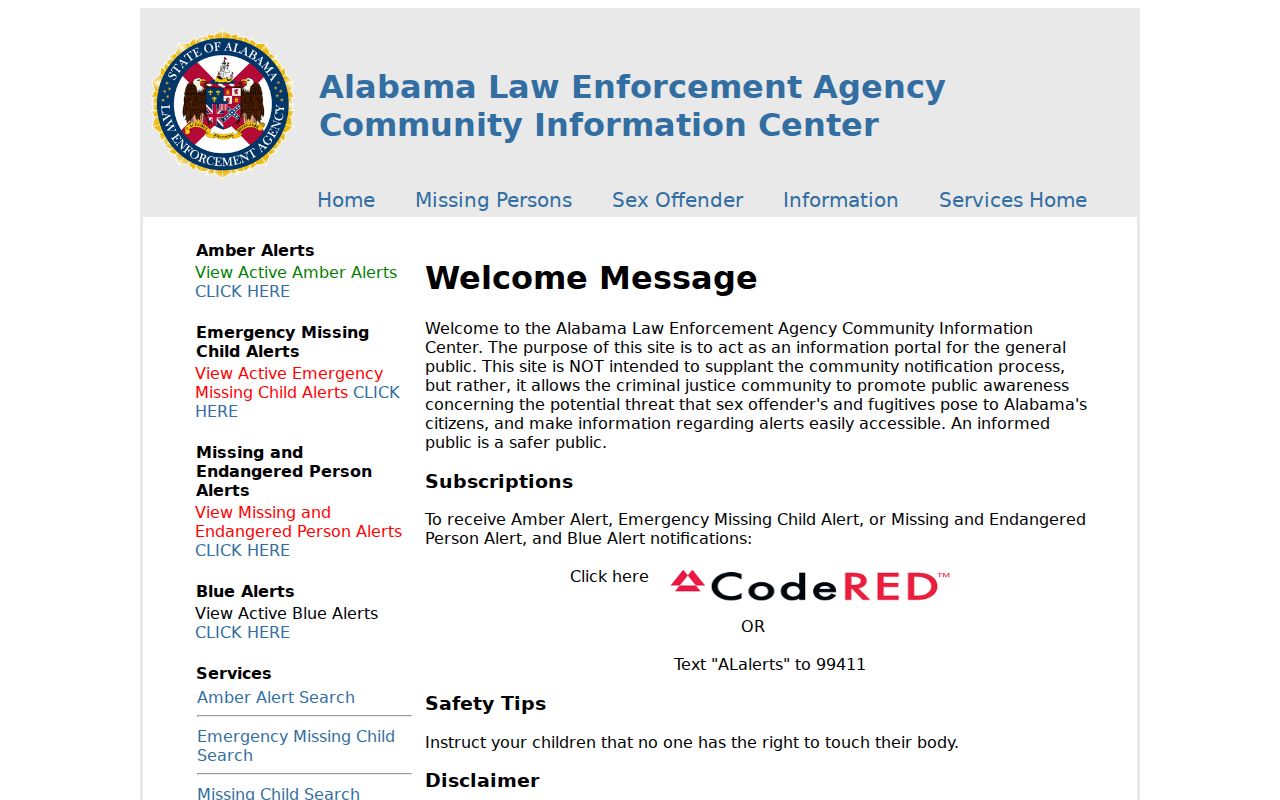
The vendor can place an anti-bot step before the live form. Exact radius choices and button labels should be read from the active interface rather than assumed.
A Walker County search and an address search answer different questions. Selecting Walker can return records spread across its communities. An address and radius can focus on a neighborhood, while a name can locate a known profile. None of those modes proves that a missing person has no qualifying history because public dissemination exclusions still apply.
Searching the Alabama Sex Offender Registry
A Walker County sex offender search works best when the fields match the purpose. Use a known first and last name for identity. Use Walker County, a city, ZIP code, or address for local awareness. The search form does not state that every field is required.
- Open the official ALEA registry gateway and read the terms and safety notice.
- Enter a name, or choose a location field such as Walker County, city, ZIP code, address, or radius.
- Review the list or map results and match the correct profile without relying on location alone.
- Open the profile and read the reported address, offense, physical description, and registration details together.
| Field label | Type | Required | Notes |
|---|---|---|---|
| Last Name | Text | Unspecified | Use with first name when known |
| First Name | Text | Unspecified | Optional narrowing field |
| Address | Text | Unspecified | Geographic starting point |
| City or Town | Text | Unspecified | Locality search required by state law |
| County | Dropdown | Unspecified | Select Walker for countywide results |
| ZIP Code | Text | Unspecified | Five-digit locality search |
| Geographic Radius | Dropdown | Unspecified | Live distance choices must be confirmed |
Alabama law requires field-search capability by name, city or town, county, ZIP code, and geographic radius. The map and list are entry points to the same profile data. Use the list details as the authoritative route instead of measuring a map point or treating a visual pin as the full record.
Walker County Registry Scope Limits
Not every person with a sex-offense history appears in public Walker County results. ALEA describes exclusions and special rules for some juvenile, youthful-offender, and out-of-state cases. Its public guidance also states that certain first convictions for indecent exposure or sexual misconduct do not appear. An absent result is therefore not proof of no criminal history or no legal duty.
The manifest image below comes from ALEA's official Alabama registry scope page.
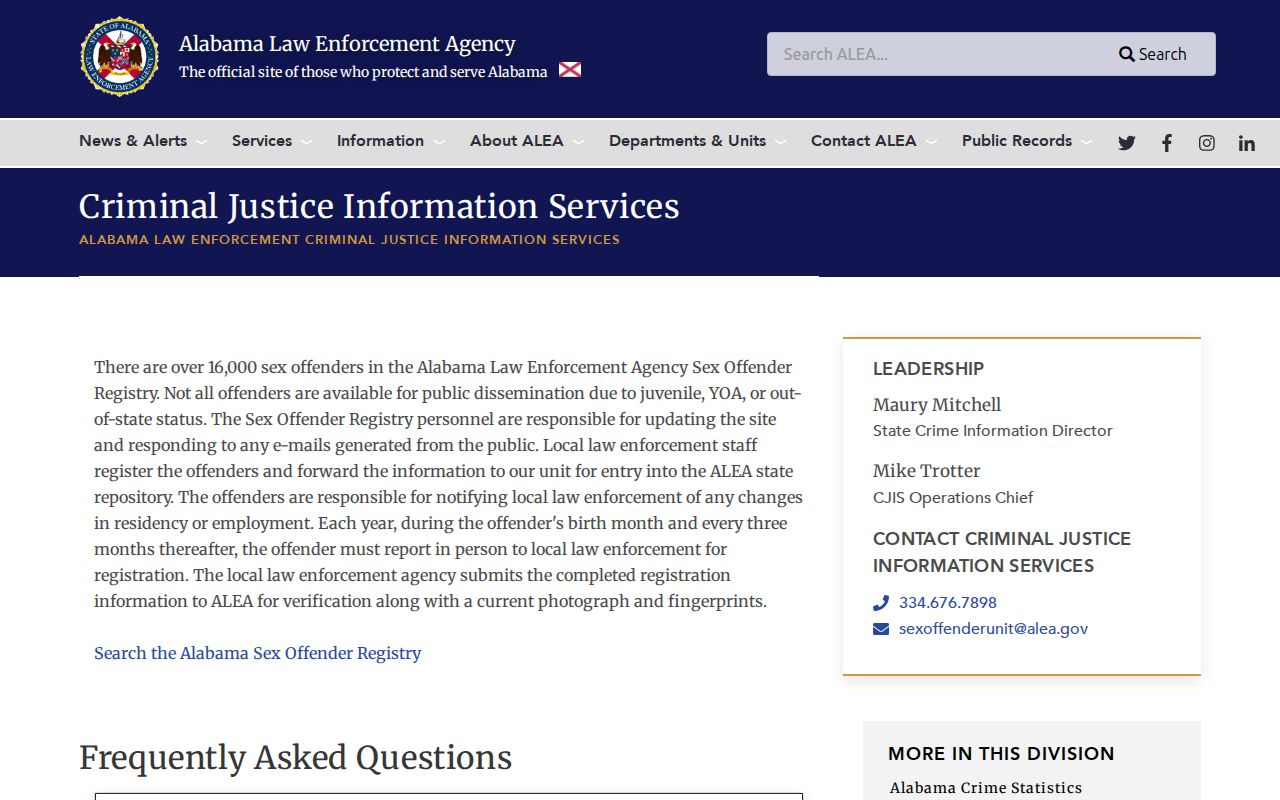
The scope page explains what ALEA makes public. It also supports a key distinction: registry disclosure and criminal-history disclosure follow different legal rules.
What a Registry Profile Shows
Alabama Code section 15-20A-8 defines the public field set. A specific Walker County profile may show only the fields that apply. The profile is not a full case narrative, and its offense line should not be expanded by guesswork about facts, risk, or another person at the address.
| Name and aliases | Current name, aliases, and legal-name changes when supplied. |
|---|---|
| Photo and description | Photograph, age or birth information, sex, race, height, weight, hair, eyes, and identifying marks. |
| Reported residence | Current or reported location and possible homeless or noncompliant indicators. |
| Qualifying offense | Offense, conviction jurisdiction and date, and authorized victim age or sex information. |
| Registration details | Compliance information and the registering local law-enforcement agency. |
| Vehicles and school | Reported vehicle identifiers, school information, and other statutorily public data. |
Internet identifiers can be collected as registration information, but a reader should not assume each collected field appears publicly. Use the live Walker County profile and statute for the actual display. The same caution applies to vehicle, school, and victim-related fields because the exact subset varies by record.
Walker County Registry Verification
Local law enforcement collects registration and verification information, including updates, photographs, and fingerprints, then forwards it to ALEA. Adult registrants generally appear during their birth month and every three months afterward. Alabama law sets a $10 quarterly fee. The initial acknowledgement calls for in-person registration within three business days after release or conviction when the person is not incarcerated.
The manifest image is linked to the Alabama administrative rule for electronic registry data.
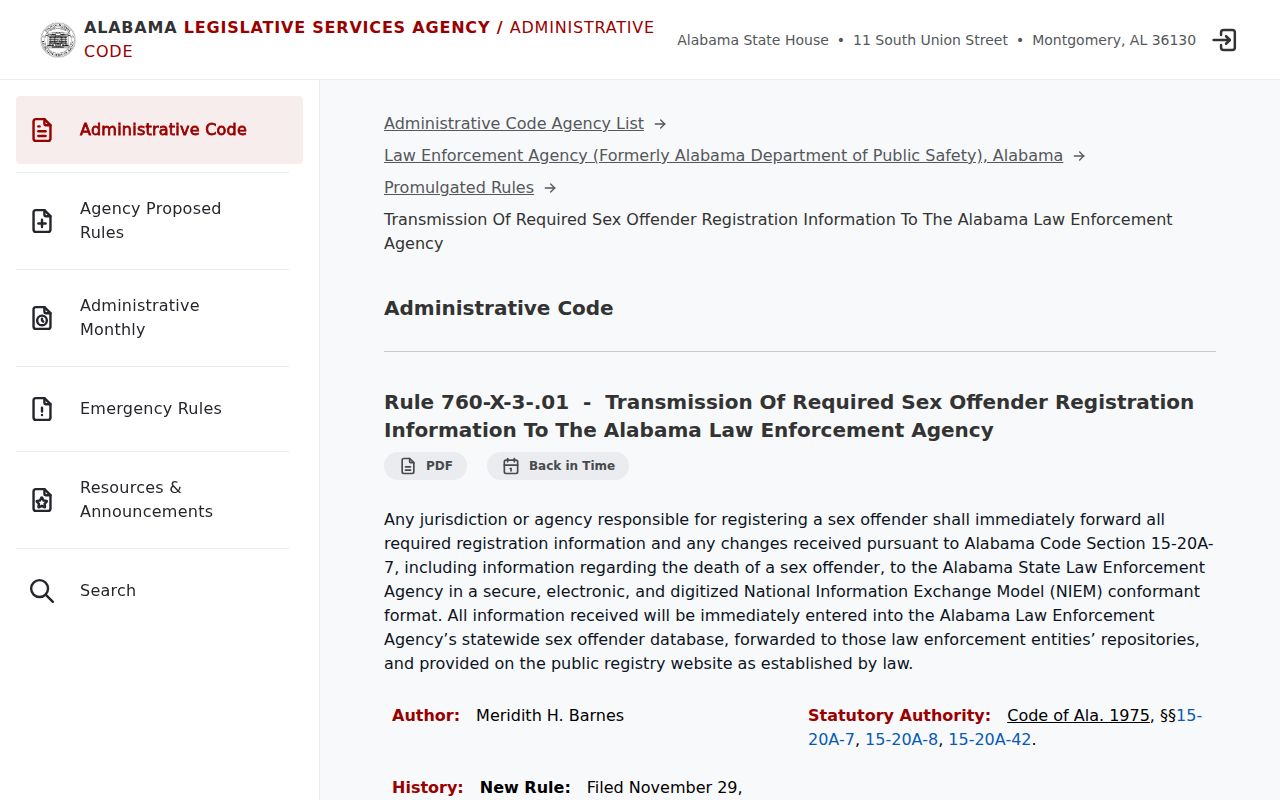
The local-to-state flow explains why a suspected error should go to Walker County law enforcement or ALEA instead of being treated as settled fact.
ALEA's own registry unit can also address state-system questions at 334-676-7898 or sexoffenderunit@alea.gov. Local registration facts begin with Walker County, while a display or statewide-system issue may need ALEA. Give the profile information and describe the apparent error without publishing it or contacting anyone at the reported location.
Registration Requirements and Levels in Alabama
Alabama does not use the simple public Tier I, Tier II, and Tier III table found in federal summaries. Walker County registry duties follow Alabama's adult-lifetime and juvenile statutory framework. Do not assign a federal tier from the listed offense or label every public profile as the same risk level.
| Alabama category | Duration | Verification or public treatment |
|---|---|---|
| Adult sex offender | Generally lifetime | Birth month and every three months thereafter |
| Specified juvenile, age 14+ at offense | Lifetime; petition may be possible after 25 years from release | Rules depend on the listed serious offense |
| Other juvenile sex offender | Ten years from first registration | Court risk assessment and notification rules apply |
| Youthful offender | Special statutory treatment | ALEA says public posting generally requires age over 18 at offense |
Note: Federal SORNA tier language does not replace Alabama's own Walker County registration categories, duration rules, or court procedures.
Adult registrants in Walker County generally have lifetime registration duties under ASORCNA. Specified juveniles who were at least 14 at the offense can also face lifetime registration, with a statutory petition route after 25 years from release. Other juvenile registration can run ten years from first registration. Youthful-offender status has separate rules. Only the governing Alabama category and court record can establish the actual duty.
Wrong Walker County Registry Data
An old address may indicate noncompliance rather than a website batch delay because ALEA describes daily real-time updates from local submissions. It can also reflect a disputed or newly changing fact. Do not visit the address or confront anyone. Report a suspected violation to the Walker County Sheriff's Office sex-offender questions line at 205-302-6179. Use 911 only for an emergency.
Walker County Registry Questions
Walker County Sheriff's Office
2001 Second Avenue
Jasper, AL 35501
205-302-6179
Main office: 205-302-6464
Monday-Friday, 8:00-4:00
The sheriff's official registry questions page supplied the manifest image.
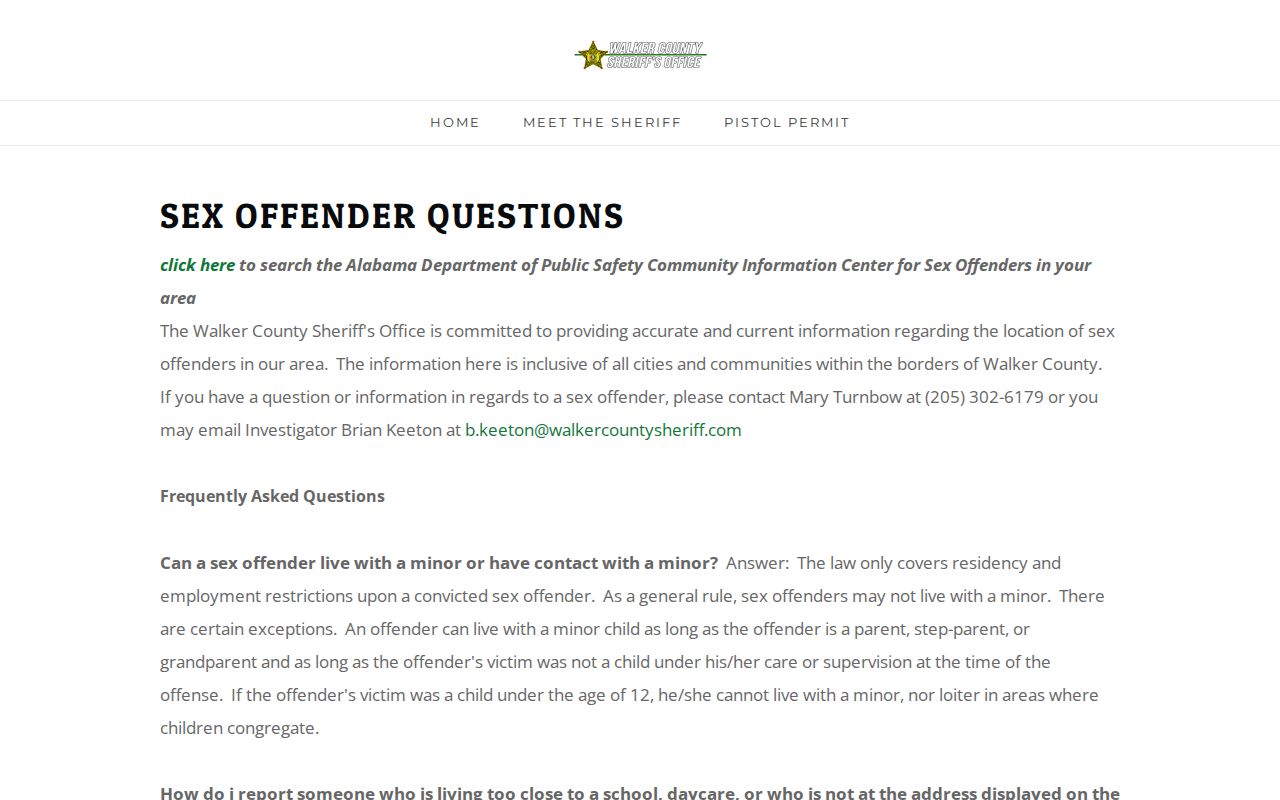
That local contact is the right path for a compliance concern across Walker County communities.
The official Walker County Sheriff's Office site gives the main agency contact, while the Walker County government directory provides the broader county-office route. Use those official channels when a saved page or phone listing is unclear.
Walker County Registry Search Layers
Use the official tool that matches the question. ALEA is the primary source for Alabama and Walker County. A name search can narrow to a known person. An address, county, city, ZIP, or radius search supports local awareness. The U.S. Department of Justice's National Sex Offender Public Website adds a cross-state layer when a search extends beyond Alabama.
The NSOPW source supplied the national-search manifest image.
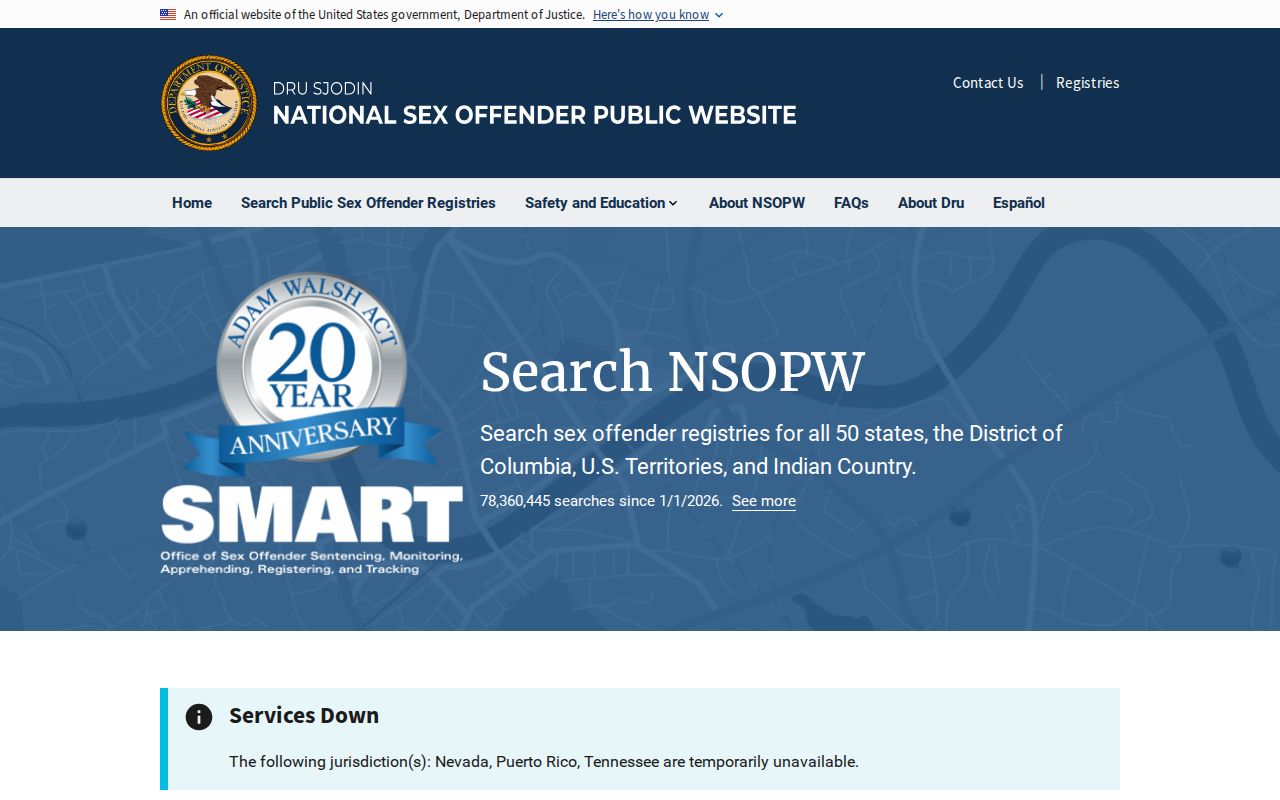
National search is a supplement, not a replacement for the live Alabama profile or the Walker County reporting line.
Cross-state search is most useful when a known person has ties outside Alabama or an area of concern crosses a state line. For a Walker County location, return to ALEA for the current Alabama profile and to the sheriff for local verification. Different jurisdictions can apply different publication rules, so an NSOPW no-match is not a universal clearance.
Lawful Use and Community Notification
Walker County registry data supports family and community safety planning. Alabama's notice radius changes with community size. In many cities of at least 5,000 people, police or the sheriff notify residences within 1,500 feet and schools or child-care facilities within three miles. In smaller municipalities and unincorporated areas, the residence radius is 2,000 feet while the school and child-care radius remains three miles.
Residence restrictions are legal duties, not a map of safety. A point inside a radius does not prove noncompliance, and a map cannot establish who else lives or works at a reported address. Use the source profile, avoid republishing it, and route concerns to law enforcement.
Alabama guidance also describes a 2,000-foot residence rule around schools and child-care facilities and special 500-foot loitering restrictions for certain offenses involving a child under 12. Those distances define duties in specified circumstances. They do not turn every nearby location into evidence of a violation. Local law enforcement, not a map viewer, investigates the facts.
Misuse is unlawful: Alabama Code section 15-20A-8 warns that injuring, harassing, or committing a crime against a listed person or anyone at a reported address may result in criminal penalties.